Saturday, April 11, 2020
I Have Earned my Single Subject Teaching Credential and my M.Ed.
As of 4/11/2020 I have earned both my Single Subject English Credential and my M.E.d. Thank you to everyone who supported me.

Thursday, June 6, 2019
Professional Development: Online Mandated Reporting Course
Act 31 Training Requirement for Mandated Reporters starts 1/1/15
- For LSW, LCSW, LPC and LMFT license holders- new licensees must complete 3 hours of training, licensee renewals must have 2 hours of training.
- These training hours can count toward the overall number of training hours needed to maintain licensure.
As of 06/06/2019 I have met this requirement.

Sunday, May 26, 2019
Reference List - 24 Teaching Strategies
Resources:
These are the resources for:
A: Twelve General Teaching Strategies
B: Twelve ELA Teaching Strategies
10
Benefits of Inquiry-Based Learning -. (2017). Retrieved from
https://www.teachthought.com/critical-thinking/10-benefits-of-inquiry-based-learning/
Annotating
and Paraphrasing Sources. (2019). Retrieved from
https://www.facinghistory.org/resource-library/teaching-strategies/annotating-and-paraphrasing-sources
CAST:
About Universal Design for Learning. (2019). Retrieved from
http://www.cast.org/our-work/about-udl.html#.XOgmdxZKiUk
Character
Maps. (2019). Retrieved from https://www.facinghistory.org/resource-library/teaching-strategies/character-maps
Clever
Prototypes, L. (2019). Plot of a Story | Plot Diagram Template. Retrieved from
https://www.storyboardthat.com/articles/e/plot-diagram
Close
Reading Protocol. (2019). Retrieved from
https://www.facinghistory.org/resource-library/teaching-strategies/close-reading-protocol
Collaborative
Learning | Center for Teaching Innovation. (2019). Retrieved from
https://teaching.cornell.edu/teaching-resources/engaging-students/collaborative-learning
Connect,
Extend, Challenge. (2019). Retrieved from
https://www.facinghistory.org/resource-library/teaching-strategies/connect-extend-challenge
Cox,
J. (2019). Top 5 Teaching Strategies. Retrieved from
https://www.teachhub.com/top-5-teaching-strategies
Effective Teaching
Strategies For The Classroom - Quizalize Blog. (2018). Retrieved from
https://www.quizalize.com/blog/2018/02/23/teaching-strategies/
Exit
Cards. (2019). Retrieved from
https://www.facinghistory.org/resource-library/teaching-strategies/exit-cards
Exit
Slips | Classroom Strategy | Reading Rockets. (2019). Retrieved from
http://www.readingrockets.org/strategies/exit_slips
Five
Strategies for Effective English Teachers. (2012). Retrieved from
https://education.cu-portland.edu/blog/classroom-resources/teaching-strategies-for-english-teachers/
Gallery
Walk. (2019). Retrieved from
https://www.facinghistory.org/resource-library/teaching-strategies/gallery-walk
Glass,
C., & Zygouris-Coe, V. (2004). Making Connections: Text to Self, Text to
Text, Text to World - Diane Kardash. Retrieved from https://sites.google.com/a/alaska.edu/diane-kardash/Home/making-connections
Goodwin,
J. (2018). Top 10 Teaching Strategies to Use in Your Classroom. Retrieved from
https://go.magoosh.com/schools-blog/top-10-teaching-strategies
Guido,
M. (2015). 20 Differentiated Instruction Strategies & Examples | Prodigy.
Retrieved from
https://www.prodigygame.com/blog/differentiated-instruction-strategies-examples-download/
How to
Motivate Students by Letting Them Choose Books. (2019). Retrieved from https://www.teachhub.com/how-motivate-students-letting-them-choose-books
Jigsaw
| Classroom Strategy | Reading Rockets. (2019). Retrieved from
http://www.readingrockets.org/strategies/jigsaw
Juraschka, R. (2019). 4
Reciprocal Teaching Strategies To Use. Retrieved from
https://www.prodigygame.com/blog/reciprocal-teaching/
Khan,
B. (2019). 4 Major Benefits of Close Reading | Literacy in Focus | A Blog For
Teachers. Retrieved from https://litinfocus.com/4-major-benefits-close-reading/
Lynch,
E. (2019). Annotating Text Strategies That Will Enhance Close Reading
[Printable Resources]. Retrieved from
https://www.sadlier.com/school/ela-blog/teaching-annotation-to-students-grades-2-8-annotating-text-strategies-that-will-enhance-close-reading
News,
B. (2015). Why peer editing is beneficial for young writers - Bright Education
Blog. Retrieved from
http://brightedblog.funeducation.com/blog/common-core-state-standards-news/why-peer-editing-is-beneficial-for-young-writers
Mansaray,
H. (2013). Nine Strategies for Reaching All Learners in English Language Arts.
Retrieved from
https://www.edutopia.org/blog/stw-expanded-learning-time-individualized-learning-hassan-mansaray
Mareco,
D. (2017). 10 Reasons Today’s Students NEED Technology in the Classroom.
Retrieved from
https://www.securedgenetworks.com/blog/10-reasons-today-s-students-need-technology-in-the-classroom
Masten,
M. (2017). 7 Reasons Why Differentiated Instruction Works | ASCD Inservice.
Retrieved from
http://inservice.ascd.org/7-reasons-why-differentiated-instruction-works/
Pappas,
C. (2015). 7 Benefits Of Mistake-Driven Learning - eLearning Industry. Retrieved
from https://elearningindustry.com/7-benefits-of-mistake-driven-learning
Text-to-Text,
Text-to-Self, Text-to-World. (2019). Retrieved from
https://www.facinghistory.org/resource-library/teaching-strategies/text-text-text-self-text-world
Think-Pair-Share
| Classroom Strategies | AdLit.org. (2019). Retrieved from
http://www.adlit.org/strategies/23277/
Top 5
Reasons Learning Vocabulary is Important. (2019). Retrieved from
https://www.k5learning.com/blog/top-5-reasons-learning-vocabulary-important
Top 5
Teaching Strategies. (2019). Retrieved from
https://www.teachhub.com/top-5-teaching-strategies
Yin,
H. (2010). Seeing the Value of Visualization | SingTeach | Education Research
for Teachers. Retrieved from http://singteach.nie.edu.sg/issue22-mathed/
Visualization
to Improve the Speed of Understanding - mysimpleshow. (2019). Retrieved from
https://www.mysimpleshow.com/visualization-improve-speed-understanding/
What is Community-Based
Learning? - Center for Teaching & Learning - Marshall University. (2019).
Retrieved from https://www.marshall.edu/ctl/community-engagement/what-is-service-learning
Why Use Gallery Walk?.
(2019). Retrieved from https://serc.carleton.edu/introgeo/gallerywalk/why.html
Word Analysis | Power
Up What Works. (2019). Retrieved from
https://powerupwhatworks.org/strategy-guide/word-analysis
Word Walls | Classroom
Strategy | Reading Rockets. (2019). Retrieved from
http://www.readingrockets.org/strategies/word_walls
Wolpert-Gawron, H.
(2016). What the Heck Is Inquiry-Based Learning?. Retrieved from
https://www.edutopia.org/blog/what-heck-inquiry-based-learning-heather-wolpert-gawron
Writing
Workshop > Overview | LEARN - Children's Literacy Initiative. (2019).
Retrieved from https://learn.cli.org/best-practices/writing-workshop/overview
Zorfass,
J. (2019). Word Analysis to Expand Vocabulary Development. Retrieved from
http://www.readingrockets.org/article/word-analysis-expand-vocabulary-development
Twelve ELA Teaching Strategies
12 Teaching Strategies
for English
In addition to general
teaching strategies, any English teacher will also need to have strategies
aimed specifically at teaching English. With a variety of learning ability
levels and unique needs these are a few methods to ensure everyone masters the
content.
 1: Vocabulary Building: Virtually any
new narrative will come with vocabulary and phrases the students are not
familiar with. Vocabulary building involves identifying these unfamiliar words
and using interactive vocabulary building strategies to increase the students’
familiarity with the narrative’s new vocabulary before reading it begins ("Five
Strategies for Effective English Teachers", 2012). This skill is important
for reasons beyond the obvious ones. In addition to helping students understand
what they read, increased vocabulary increases their ability to use logic and
persuade others. Often, we find ourselves judged on the quality of our speech.
Obviously, the more developed the student’s vocabulary, the better impression
the student will make ("Top 5 Reasons Learning Vocabulary is
Important", 2019).
1: Vocabulary Building: Virtually any
new narrative will come with vocabulary and phrases the students are not
familiar with. Vocabulary building involves identifying these unfamiliar words
and using interactive vocabulary building strategies to increase the students’
familiarity with the narrative’s new vocabulary before reading it begins ("Five
Strategies for Effective English Teachers", 2012). This skill is important
for reasons beyond the obvious ones. In addition to helping students understand
what they read, increased vocabulary increases their ability to use logic and
persuade others. Often, we find ourselves judged on the quality of our speech.
Obviously, the more developed the student’s vocabulary, the better impression
the student will make ("Top 5 Reasons Learning Vocabulary is
Important", 2019).
2: Peer Response and Editing: Peer
Response and Editing allows students to think critically about each other’s
work. It also allows students to see how their classmates tackled the same
writing assignment, which may get the students to come up with new approaches
they might not have thought of without the peer-editing step ("Five
Strategies for Effective English Teachers", 2012). Peer editing is
beneficial to students for numerous reasons. Those reasons include that writers
need a wide variety of feedback and there are always enough peers in a class to
give that wide variety of feedback. Additionally, peer editing helps students accept
constructive criticism and gives them deeper insight into their own writing
process (News, 2015).
3: Student-Chosen Texts: When students
are given a wide variety of choices of age-appropriate literature they are more
likely to remain engaged and become life-long readers. After some time spent
reading independently the students might break into groups and discuss what
they read. This is usually followed by independent journaling. When this
strategy is done well it can result in students understanding the material they
read on a much deeper level, which in turn can lead to productive discussions
with their classmates ("Five Strategies for Effective English
Teachers", 2012). Allowing students to chose texts is beneficial on
several levels. In addition to increased engagement, student choice is linked
to scholastic achievement. It will also cause students to read more, improve
their writing skills, and give the instructor a better idea which narratives
will be interesting to their students ("How to Motivate Students by
Letting Them Choose Books", 2019).
 4: Writer’s Workshop: Writers workshop
allows students to participate in every part of the writing process: drafting,
editing, revision, and publishing. ("Five Strategies for Effective English
Teachers", 2012). It can be tied back into virtually any subject the
students are studying. During writer’s workshop the students practice becoming
capable writers. While they may start by choosing the topic, the instructor
will become involved in helping students with organizing their writing,
choosing their words, editing for mechanics, or expressing their own unique
style. Done well, Writers Workshop mixes just enough explicit and implicit
instruction that students can take on all the steps of writing in manageable chucks.
This can result in becoming capable, confident writers ("Writing Workshop
> Overview | LEARN - Children's Literacy Initiative", 2019).
4: Writer’s Workshop: Writers workshop
allows students to participate in every part of the writing process: drafting,
editing, revision, and publishing. ("Five Strategies for Effective English
Teachers", 2012). It can be tied back into virtually any subject the
students are studying. During writer’s workshop the students practice becoming
capable writers. While they may start by choosing the topic, the instructor
will become involved in helping students with organizing their writing,
choosing their words, editing for mechanics, or expressing their own unique
style. Done well, Writers Workshop mixes just enough explicit and implicit
instruction that students can take on all the steps of writing in manageable chucks.
This can result in becoming capable, confident writers ("Writing Workshop
> Overview | LEARN - Children's Literacy Initiative", 2019).
5: Annotating and Paraphrasing Sources: Annotating
and paraphrasing requires students to underline key words, write margin notes,
and summarize main ideas as they read a primary or secondary source ("Annotating
and Paraphrasing Sources", 2019). Careful annotations will improve both
reading comprehension and writing skills. It also gives cues into the authors
tone, the narratives mood, and the author’s perspective and potential bias.
When done with purpose, annotations keep track of main ideas, prompt thought
provoking questions, and help the reader make inferences as well as draw conclusions
about the text (Lynch, 2019).
6: Character Maps/ Plot Diagrams:
Character Maps are graphic organizers that use a simple drawing of a person,
with questions connected to the characters physical, mental, emotional, and
social traits. Character maps can be used with historical or fictional
characters ("Character Maps", 2019). Meanwhile, plot diagrams serve
to map out the exposition, conflict, rising action, climax, resolution, and
falling action of a narrative. Plot diagrams help students pick out major
elements of a narrative. They also help the reader understand how dynamic
characters change over time. In addition to honing the student’s analytic
skills, filling one out also meets several Common Core standards related to
literacy (Clever Prototypes, 2019).
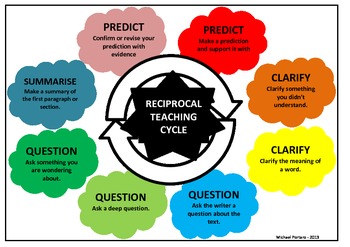 7: Reciprocal Teaching: Within this
strategy, teachers challenge students to interact more with the text they are
reading. The students are taught strategies like predicting, questioning,
making inferences, clarifying, or summarizing before they begin to read. The
students practice these skills in groups, as they move towards being
comfortable using them on their own. Done well this strategy can boost reading
comprehension, engage readers, improve literacy, and help students work more
effectively in groups. It also sets a secondary purpose for reading, which
gives the students a well-defined direction as they start to read (Juraschka,
2019).
7: Reciprocal Teaching: Within this
strategy, teachers challenge students to interact more with the text they are
reading. The students are taught strategies like predicting, questioning,
making inferences, clarifying, or summarizing before they begin to read. The
students practice these skills in groups, as they move towards being
comfortable using them on their own. Done well this strategy can boost reading
comprehension, engage readers, improve literacy, and help students work more
effectively in groups. It also sets a secondary purpose for reading, which
gives the students a well-defined direction as they start to read (Juraschka,
2019).
8: Making Text Connections: Text
connections are about making reading more meaningful. They usually come in
three forms: text-to-text connections, text-to-world connections, and
text-to-self connections. Making these connections as they read also gives
students a purpose for reading. And, when students have set a purpose they will
be more likely to comprehend the meaning of the text ("Text-to-Text,
Text-to-Self, Text-to-World", 2019). Using this strategy helps readers
understand a characters motivations. It also keeps readers involved, thus
alleviating boredom. Moreover, when using strategies like text-to-text and
text-to-world students see the narrative through parallel structure or through
the eyes of others who read it before them (Glass & Zygouris-Coe, 2004)
9: Word Walls: A word wall creates a
space in a classroom where relevant vocabulary is prominently displayed. To be
effective word walls should be placed where all students can see them. Teachers
and students should decide together which words will go on the world wall. New information
should be added to the word wall on a regular basis. And the instructor should
refer back to the word wall in his or her instruction. Word walls are helpful
because they help students identify patterns between the words and their
spellings. Additionally, students are able to use them as a reference when
engaged in any reading or writing activity ("Word Walls | Classroom
Strategy | Reading Rockets", 2019).
 10. Close Reading: Close Reading
Protocol asks students to reread smaller portions of the text. During a close
read the students may focus on the author’s purpose, the text structure, or
what specific words mean in context. Close reads are important as they help
students identify text evidence to back up their own claims. Additionally, the
attention to the small details of the text ensure that students truly
comprehend what they are reading ("Close Reading Protocol", 2019).
Using this process students focus on what the text says, how the text says it,
and what the underlying meaning is. Close reading is beneficial as it addresses
some concerns of Common Core, develops critical thinking, and can be used in a
cross-curricular way (Khan, 2019).
10. Close Reading: Close Reading
Protocol asks students to reread smaller portions of the text. During a close
read the students may focus on the author’s purpose, the text structure, or
what specific words mean in context. Close reads are important as they help
students identify text evidence to back up their own claims. Additionally, the
attention to the small details of the text ensure that students truly
comprehend what they are reading ("Close Reading Protocol", 2019).
Using this process students focus on what the text says, how the text says it,
and what the underlying meaning is. Close reading is beneficial as it addresses
some concerns of Common Core, develops critical thinking, and can be used in a
cross-curricular way (Khan, 2019).
11: Genre Immersion: Genre Immersion
gives the students a few weeks to look at narratives that fall within the same
genre. There are numerous benefits to staying on the same genre for a few weeks.
First and foremost, that’s the way most ELA texts are set up. Units tend to
focus on several stories with similar structure. There may be one unit on
fables, followed by a unit on realistic fiction, followed by a unit on
expository text (Mansaray, 2013). Immersion exposes students to high-quality
examples of a specific genre. In doing so, students internalize the language,
structure, form, purpose, and possibilities of each genre. This is critical
before expecting students to write within that genre.
12: Word Analysis: Using this skill
students break words down into morphemes, their smallest units of meaning. Each
morpheme has a meaning that contributes to the whole word. This helps students
build up to the word, even if they have never been exposed to the word they are
looking at before. Because much of English is borrowed, there are many words in
the lexicon, that it’s critical to understand the prefixes, suffixes, roots,
and word origin to keep up. Though word analysis can be tedious, it can
certainly help students keep up ("Word Analysis | Power Up What
Works", 2019). Word analysis is a foundational reading skill, it is
critical for students who are developing their vocabulary, and it also
satisfies several literacy-related Common Core Standards (Zorfass, 2019).
* The resource list for both teaching strategies pages can be found HERE.
Sunday, May 12, 2019
My Subject and Content Area
 My name is Shayne M. Whitehead. I am a graduate of ASU’s journalism program. My content area is English Literature and English itself. I chose this content area because I have always had a large imagination and writing is one of the few skills that can take that imagination anywhere. The nuances of English are necessary for all other fields from reviewing history, to solving equations. You need a solid foundation in English to be proficient in math, science, history, and any kind of performance art. Effective communication is a spring board for all other disciplines; therefore, mastering it become crucial to success everywhere else. I also chose it because English is a flexible field to study. Math is somewhat rigid. Two plus two always equals four. Some students like questions with one answer; I like a wide range. I think it’s because I always felt like it improved my chances of answering correctly. There are always multiple ways of communicating a point, and I love the flexibility English gives me when more than one answer a direct question. It can also be a challenge when I get to the editing phase of writing, not to mention grading as an instructor.
My related content standard is CCSS.ELA-LITERACY.RL.11-12.7. Analyze multiple interpretations of a story, drama, or poem (e.g., recorded or live production of a play or recorded novel or poetry), evaluating how each version interprets the source text. (Include at least one play by Shakespeare and one play by an American dramatist.) I think I first gained an appreciation for this skill when an English teacher asked me to imagine the Diary of Anne Frank, if it were told from another character’s point of view. So many questions formed in my mind, and with each new one, I had a deeper understanding and appreciation for the dairy in its original form. Each question the new POV generated gave me more insight into Anne's experience and her relationship with the other characters she went into hiding with.There are so many retellings of each classic, that finding the uniqueness of the tone, mood, and theme in each new interpretation becomes a unique escapade into investigation and discovery. Looking for those nuances aligns well with both Concept-Based and Project-Based learning. When you’re interpreting these works it requires students to formulate a hypothesis and find the text-evidence to support it. Shakespeare’s tone, mood, and theme will change each time the story is told from a new point of view. Romeo and Juliet could be a lesson on fate, it could be a warning about family pride, and it could also be meant to question our ideas of love over loyalty and loyalty over love. It all depends on who is telling the story and how the listener hears it when they do. Once they learn to find those differences they can start to see how things like point of view can alter or enhance as story's tone, mood, and theme.
My Learning and Teaching Style
My Learning Style
In ITL 528, took all four teaching and learning surveys. According to the results, I have a similar personality to George Washington and Cliff Claven from Cheers. Due to conflicts like that, I will take each survey with a grain of salt. However, there are quite a few places were the results of each survey overlap. Both personality surveys say I am an introvert. Though the second personality survey said I was more much more introverted than the first. Both surveys also suggested I rely on my senses more than my intuition and my judgment more than my perception. The initial survey suggests I feel my way through problems more than I think my way through them. The second personality survey reversed that.
I wasn’t surprised by this. I think I prefer to think my way through things, but often due to impatience, I will look for a quicker road feeling my way to the answer.
The initial survey suggests that I am a quiet, serious observer of people, listening intently and getting to know a great deal about them. It suggests that I pay attention to emotions and feelings. Further, it suggests that I have deeply-held values that direct the things that I do and say. I take a caring and sensitive approach to others, more so than may be apparent to others because I would show my feelings in acts of kindness rather than in direct statements.
How does or will your personality type affect your relationships with your students? Being an introvert makes me more sensitive to students who don’t want to put themselves on the line. However, being mostly a facilitator is probably not the best match for the current climate of education. That relates back to being a verbal introvert. As someone who had bad experiences with group work in college, I preferred instructors who lectured and tested. If you are a verbal introvert who retains facts easily, it’s a great path to earn a high grade. However, it’s important to understand that those grades aren’t great indicators of subject mastery. And just because I did well with a listen and lecture models of education, this isn’t an ideal strategy for everyone.
My Teaching Style
According to the second teaching survey, I am mostly a facilitator. My next most common teaching styles are subject expert, formal authority, delegator and personal model. According to my learning style profile I have a high to moderate preference for reflection over action. It also suggests I am much more verbal than visual. And, that I tend to think of things slightly more globally than locally.
Do I believe your personality type had an impact on the choice of my subject area? I know that my learning style and personality influences the subject area I chose to teach. Part of the reason I prefer English over subjects like math and science is the flexibility of the answers. In math, there is one correct answer to each problem. This isn’t a great path for creative or artistic thinkers. Humanities is simply a better subject for someone who wants to feel their way through a problem rather than think their way through it.
How will my teaching and/or learning style affect my teaching? Being a verbal facilitator who grew up uncomfortable with groups has forced me to expand my idea of what it means to teach. I have brief interludes in my own education that help me understand this. When a Spanish teacher asked me to visualize a “Carta” is a cart full of letters, it was horrible advice. I have no visual memory. Of course, that teacher never stopped to ask if my learning style differed from hers. I doubt she ever considered it. So, how will these results affect my teaching style? It will force me to broaden them, so that I am not only reaching students who learn in manners like myself. Knowing my own learning style ensures that I don’t over rely on it, simply because it is comfortable to me.
Resources
Index of Learning Styles Questionnaire. (2019). Retrieved from https://www.webtools.ncsu.edu/learningstyles/
Personality Test & Personality Type Test, Find who you are for Free!. (2019). Retrieved from http://kisa.ca/personality/
Personality Test, in-depth analysis of Isabel Briggs Myers types. (2019). Retrieved from https://www.metarasa.com/mmdi/questionnaire/
Teaching Style Survey. (2019). Retrieved from http://longleaf.net/teachingstyle.html
Thursday, August 30, 2018
My Autobiography and Philosophy of Education Examined
 My Autobiography and Philosophy of Education Examined
Artifact One - Complete Essay
Use the tabs above the blog for summaries & reflections
My educational philosophy is definitely
progressive, refined by a touch of realism. I realized that after taking
Introduction to Elementary Education at CSULB. The course was taught by Erin
Gruwell, the inspiration behind the film and book Freedom Writer’s Diary. It
was chaotic and unstructured. Still, somehow it worked. Mrs. Gruwell had a
talent for turning learning into a game as well as a knack for intuiting each
student’s strengths and weaknesses. In the end, you passed with an “A” because it
would be devastating to let her down.
I eventually took what I learned from
her to a third-grade literacy class I was teaching. It worked wonderfully while
I was teaching the class, yet it failed them miserably after I left.
Background
 Early
in life, my negative experiences in education were continuous. I moved from New
York to Arizona at age six. After about a year I moved again. Whatever friends
I made were always gone within a year. Because of this, and an unemotional family,
I didn’t have a support system to discuss feeling out of place. Not surprisingly,
I was bullied all the way up until middle school. Often the bullying happened
in front of my teachers. Most did nothing to intervene.
Early
in life, my negative experiences in education were continuous. I moved from New
York to Arizona at age six. After about a year I moved again. Whatever friends
I made were always gone within a year. Because of this, and an unemotional family,
I didn’t have a support system to discuss feeling out of place. Not surprisingly,
I was bullied all the way up until middle school. Often the bullying happened
in front of my teachers. Most did nothing to intervene.
According
to Eric T. Moore, author of My Educational Philosophy, “The
classroom climate must be safe, professional, and collaborative, allowing
students to feel at ease to express their views, share experiences, and discuss
differences of opinion (Moore, 2018).” In retrospect, my educational
experiences were anything but safe. That had a profound effect on me. I rarely raised my hand. I never
volunteered. And asking questions terrified me.
A turning point came in ninth grade as I
enrolled in AFJROTC. At the time, my interest in science was replaced with an
interest in creative writing. I started to devour papers on writing well; I
also started to write for the school paper. By the time I graduated high school
I was on the honor roll while maintaining almost a 3.5 average. After I enrolled at Arizona State University, I
refined my major from liberal arts to journalism. But, without a great interest
in writing about plane crashes, I eventually took my BA and became a substitute
teacher.
Analysis
 After
four years at Washington Middle School as an on-site substitute, I’ve come to
realize, I owe my students more than my own intuition about teaching. The
realization came when I watched my principal, Meghan Traver, handle a class
that I failed to control. She managed to connect that bland textbook to the
students’ lives as required by TPE 1.3. (Ctc.ca.gov,
2018). Once that happened, the classroom management took care of itself.
After
four years at Washington Middle School as an on-site substitute, I’ve come to
realize, I owe my students more than my own intuition about teaching. The
realization came when I watched my principal, Meghan Traver, handle a class
that I failed to control. She managed to connect that bland textbook to the
students’ lives as required by TPE 1.3. (Ctc.ca.gov,
2018). Once that happened, the classroom management took care of itself.
Essentialism was the philosophy I aligned
with the second most. Again, I am not surprised. While I believe in tailored
learning, I believe there are some core educational concepts that cannot be
ignored. For instance, teaching students Algebra when that student can’t pass a
timed basic multiplication test usually ends badly. Some of those core concepts
don’t lend themselves to individual tailoring.
 Ethics
So how do you maintain a balance between
tailoring curriculum to individual needs and an understanding that some core
concepts don’t lend themselves to personal tailoring? That comes with an
educator’s understanding of ethics. The Association of American Educators
breaks down ethics into four core responsibilities: the educator’s
responsibilities towards the students, the community, the educator and the
educator’s colleagues (Association of American Educators, 2018).
I found myself agreeing with most of the
responsibilities to students while questioning the requirements for continuous
growth in teaching methods. In my own experience, I think educators often throw
out old ideas because they’re old, not necessarily because they are bad ideas.
A good example with when all of LBUSD threw out Open Court, because the school
district didn’t want to focus on phonics. LBUSD instead wanted to take a
“wholistic” approach to reading and literature. However, based on my own
experience, students who can’t break words into their parts, will never get the
wholistic intent of any literature. That’s me temporarily abandoning
Progressivism for Essentialism.
Conclusion

Remember that third grade class? They
loved learning turned into a game.
Unfortunately, the teachers that came
after me didn’t all believe in that progressive theory of education. Some of
those teachers clung to the old fashion notion learning should be its own
reward. Some never tailored the lessons to the student’s own personal needs and
background. So, when some of those students encountered a different teaching
style, they couldn’t handle it. And students need to be able to handle every
kind of teaching style they might encounter.
It seems to me, the code of ethics
published by the American Association of Educators is a solid starting point
for educational ethics in general. However, I also think it occasionally ignores
that reality that one size never fits everything, including educational styles.
Subscribe to:
Posts (Atom)